


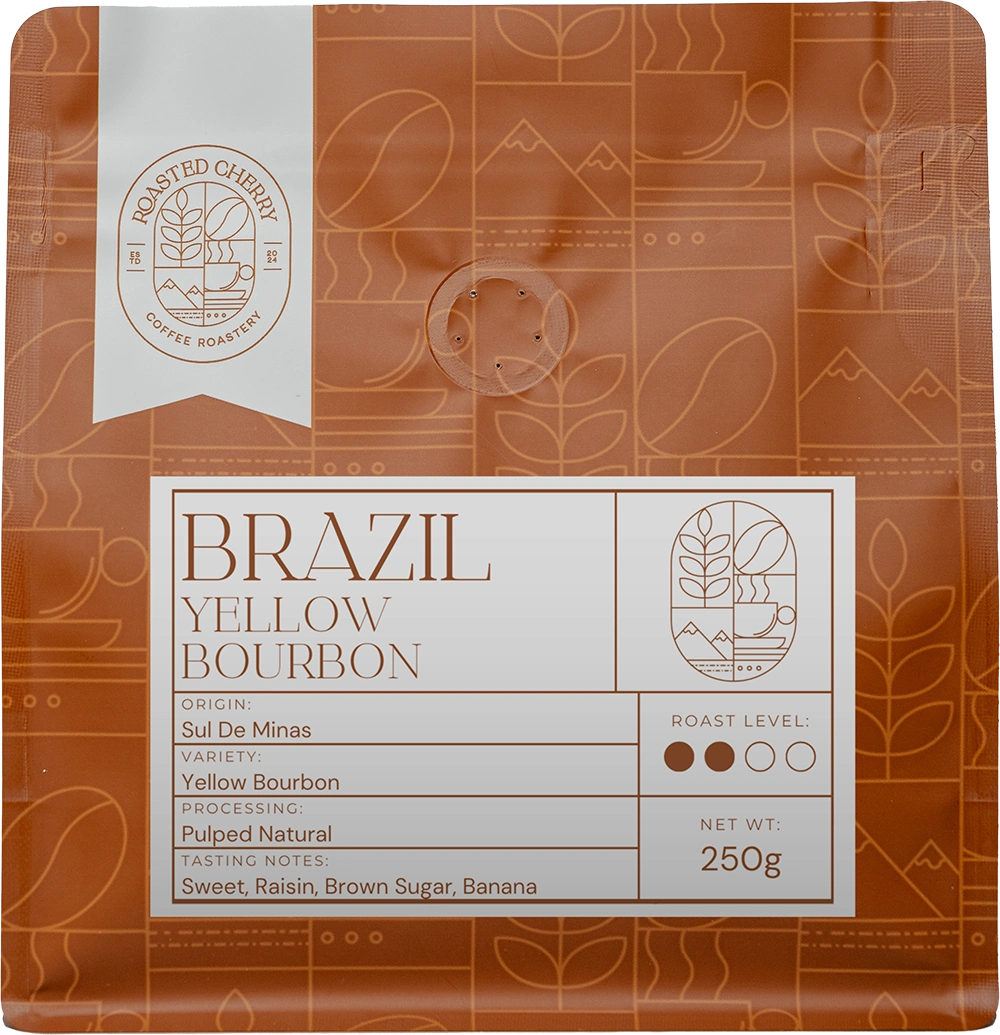
Description
Brazil Yellow Bourbon is a specific and highly-prized variety of the Arabica species. What makes it unique and easily identifiable is the color of its coffee cherries, which turn a bright yellow when ripe, rather than the more common red. This is due to a natural genetic mutation. The beans themselves are known for producing a sweet, complex, and delicate cup, often with a smooth, velvety texture.
History:
The “Bourbon” variety itself traces its history back to the island of Réunion (formerly called “Île Bourbon”) in the Indian Ocean, where it was introduced by the French. However, the Yellow Bourbon variety we know today is a more recent development with a history that is distinctly Brazilian. While the exact origin is debated, it is widely believed that Yellow Bourbon first appeared as a natural mutation. One theory suggests it was a natural cross-pollination between the original Red Bourbon and another yellow-fruited mutation of Typica called “Yellow Botucatu.” The first documented appearance of the variety as we know it today was in 1930 on a Red Bourbon farm in the state of São Paulo, Brazil. Farmers noticed the unique yellow cherries and, intrigued by their potential, began cultivating them separately. The discovery attracted the attention of the Agronomic Institute of Campinas (IAC), which began formal studies on the variety in 1942. They recognized its potential for high-quality flavor and good productivity, which led to its increased cultivation. While its yield is not as high as some modern hybrid varietals, its exceptional cup quality has secured its place as a prized specialty coffee, particularly in Brazil, where it continues to be a highlight of coffee competitions